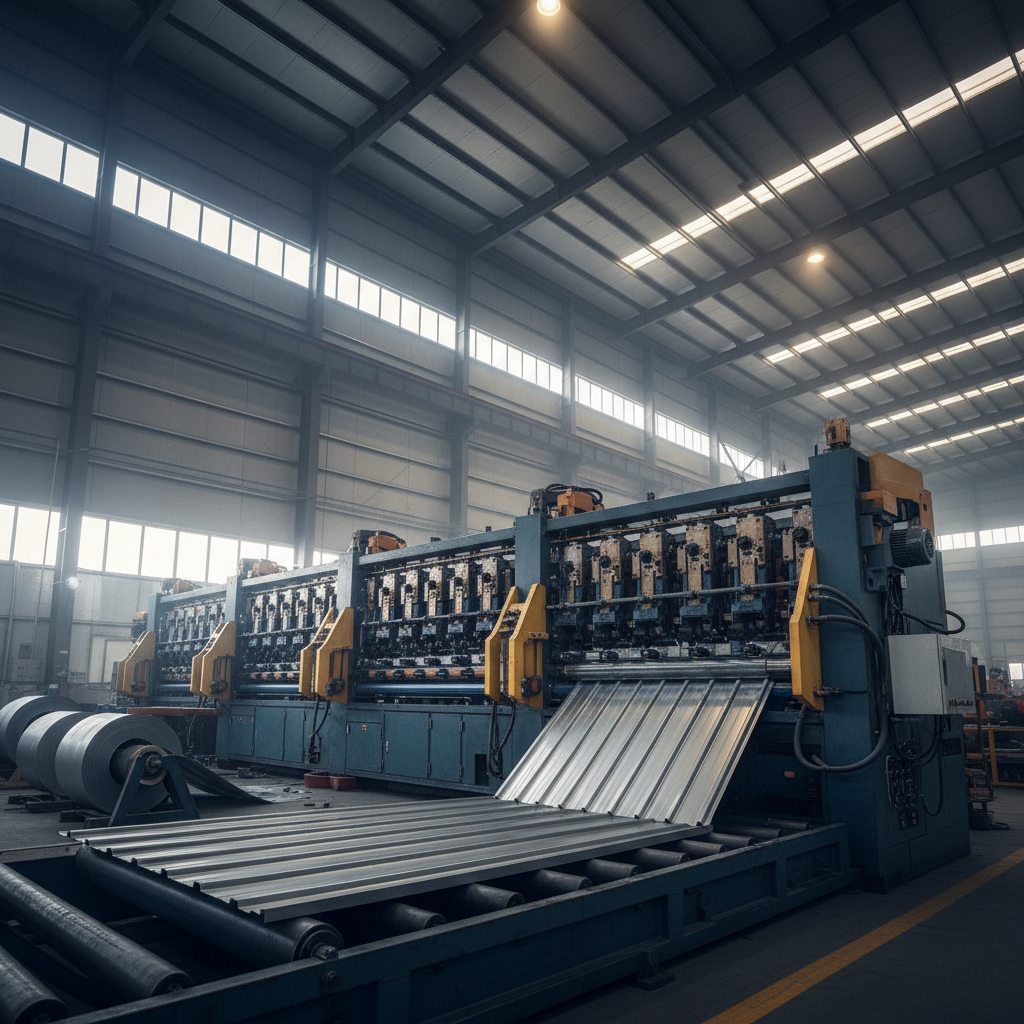
Selecting the right roll forming machine manufacturers is a critical strategic decision for companies in the metallurgical and special equipment manufacturing sectors. The precision of cold-roll forming determines the structural integrity and dimensional accuracy of components used in industrial roofing, structural framing, and architectural cladding.
Procurement managers often struggle to balance initial capital expenditure with long-term operational reliability. The challenge lies in identifying a manufacturer capable of providing not just a machine, but a complete technical solution that includes custom profile design, material compatibility analysis, and post-installation support.
This analysis provides a comprehensive framework for evaluating roll forming equipment suppliers, examining key technical specifications, performance indicators, and a decision-making matrix to ensure the acquired machinery meets specific production targets and industry standards.

Core Capabilities of Specialized Manufacturers

Experienced roll forming machine manufacturers distinguish themselves through their ability to handle complex metallurgy and custom profile engineering. Rather than offering generic equipment, top-tier suppliers integrate R&D with production, ensuring that the forming rollers are designed to minimize internal stress within the metal sheets, which prevents warping and ensures high precision.
For instance, Cangzhou Longway International Trade Co., Ltd leverages 12 years of design experience to provide a broad spectrum of solutions, ranging from C & Z purlin machines to specialized floor deck and standing seam roof panel equipment. This breadth of capability allows them to serve diverse markets across South America, North America, and Europe.
Evaluating Technical Specifications for Precision
When vetting manufacturers, technical parameters serve as the primary indicator of machine quality. Key areas of focus include the frame structure, the material of the rollers, and the control system. A robust frame, such as a 350mm H-Beam welded steel structure, is essential for maintaining alignment under high production speeds and heavy material gauges.
Attention must be paid to the forming shaft and roller material. The use of high-grade 45# forged steel for rollers and heat-treated solid shafts ensures longevity and resistance to wear. Additionally, the implementation of PLC control systems, such as Delta PLC and Inverters with touch screens, allows for precise length-set cutting and seamless operational adjustments.
Matching Machinery to Industrial Applications
The utility of a roll forming machine is defined by its profile output. For industrial buildings, TR4, TR5, and TR6 trapezoidal roof panels are standard due to their structural strength and ability to be curved. Specialized manufacturers offer package solutions that combine the forming machine with hydraulic curving machines to meet specific architectural requirements.
Beyond roofing, the application range extends to drywall profiles, door frames, and gutter systems. The choice of machine—whether it be a Double Layer Roll Forming Machine or a Stud and Track Roll Former—must align with the raw material coil type (such as PPGI, PPGL, or GI) and the required thickness range (e.g., 0.3-0.6mm) to ensure optimal production yield.
Operational Performance and Efficiency Drivers
Production efficiency is measured by the synergy between forming speed, cutting accuracy, and material waste. A separate rolling design concept is often employed by advanced manufacturers to release internal stress from the sheets, which results in a more stable profile shape and higher precision across thousands of meters of production.
The illustrative framework above demonstrates the relative impact of different technical factors on overall machine productivity. While motor power provides the necessary torque, it is the precision of the forming stations (e.g., 20 rows of rollers) and the efficiency of the hydraulic pillar cutting system that primarily drive the final output quality.
Supplier Evaluation and Risk Mitigation
Selecting a supplier involves assessing their capacity for lifetime after-sales service and technical training. In the heavy machinery industry, the risk of downtime is a significant cost driver. Manufacturers that provide a clear warranty period (such as a 2-year free warranty) and commitment to prompt technical responses (e.g., within 12 hours) offer higher operational security.
Furthermore, the ability of a manufacturer to provide comprehensive installation and training ensures that the equipment is operated within its designed parameters, reducing the likelihood of premature wear on rollers and shafts. A global footprint with partners in over 40 countries often indicates a supplier's ability to adapt to various international quality standards.
Common Procurement Pitfalls in Roll Forming
A common mistake among buyers is prioritizing the lowest initial price over the total cost of ownership. Cheap machines often utilize thinner frame structures and inferior roller materials, leading to profile deviation and frequent maintenance shutdowns. Another risk is neglecting the compatibility between the machine's power requirements (e.g., 380v/3ph/50hz) and the local facility's electrical infrastructure.
Additionally, buyers often overlook the importance of the "separate rolling" design. Machines that compress the metal too aggressively without allowing for stress release often produce sheets with "oil-canning" or wavy edges, which can lead to high rejection rates in architectural applications.
Manufacturer Comparison Decision Framework
To objectively compare roll forming machine manufacturers, procurement teams should use a weighted matrix that evaluates technical capacity, service reliability, and application specificity. The following framework compares different supplier approaches based on common industry requirements.
| Supplier Type | Technical Focus | Best Use Case | Primary Risk |
|---|---|---|---|
| Generic Supplier | Standard Profiles | Low-volume Basics | Low Precision |
| Specialized OEM | Custom Engineering | Industrial Projects | Higher Initial Cost |
| High-End Integrator | Automation/PLC | High-speed Production | Complex Maintenance |
| Regional Vendor | Local Standards | Quick Delivery | Limited R&D |
| Global Expert | International QC | Multi-country Ops | Logistics Lead-time |
| Boutique Shop | Unique Profiles | Niche Architecture | Scalability Issues |
Ultimately, the decision should be based on the specific profile requirements. For those needing high-precision trapezoidal panels for industrial sites, a manufacturer with dedicated TR-series experience and a proven track record in global exports is the most viable option.
Frequently Asked Questions
High-grade 45# forged steel is recommended for rollers due to its superior hardness and wear resistance, ensuring that the profile dimensions remain consistent over long production cycles.
Separate rolling allows the metal sheet to release internal stresses during the forming process, preventing deformation and ensuring a high-precision, smooth finish on the final profile.
Critical components include the H-beam frame structure, 20 rows of forming stations, a hydraulic pillar cutting system, and a PLC control unit for precise length management.
Yes, specialized manufacturers can customize the roller design to adjust wave height (e.g., moving beyond the standard 40mm) and the number of ribs to meet specific regional standards.
Most machines are designed for PPGI, PPGL, or GI coils, typically with widths around 1220mm and thickness ranges between 0.3mm and 0.6mm (30-22 Gauge).
Check for the availability of lifetime service, specific warranty terms, and the guaranteed response time for technical queries, which should ideally be within 12-24 hours.
Conclusion
Identifying the most suitable roll forming machine manufacturers requires a shift from focusing on price to analyzing technical capacity and long-term reliability. The combination of a heavy-duty H-beam structure, precision-engineered forged steel rollers, and a robust PLC control system is essential for maintaining high throughput and minimal waste in the metallurgical equipment sector.
For companies seeking high-precision profile solutions, detailed technical specifications and supplier experience are the best indicators of future success. Professional guidance and machinery details can be explored at www.lwrollformingmachine.com to align equipment capabilities with specific production goals.